QST1800, QST1800 Foamed Cement Wallboard Production Line
QST1800

QST1800 Foamed Cement Wallboard Production Line

Automated mould circulation line for lightweight foamed cement wall panels.

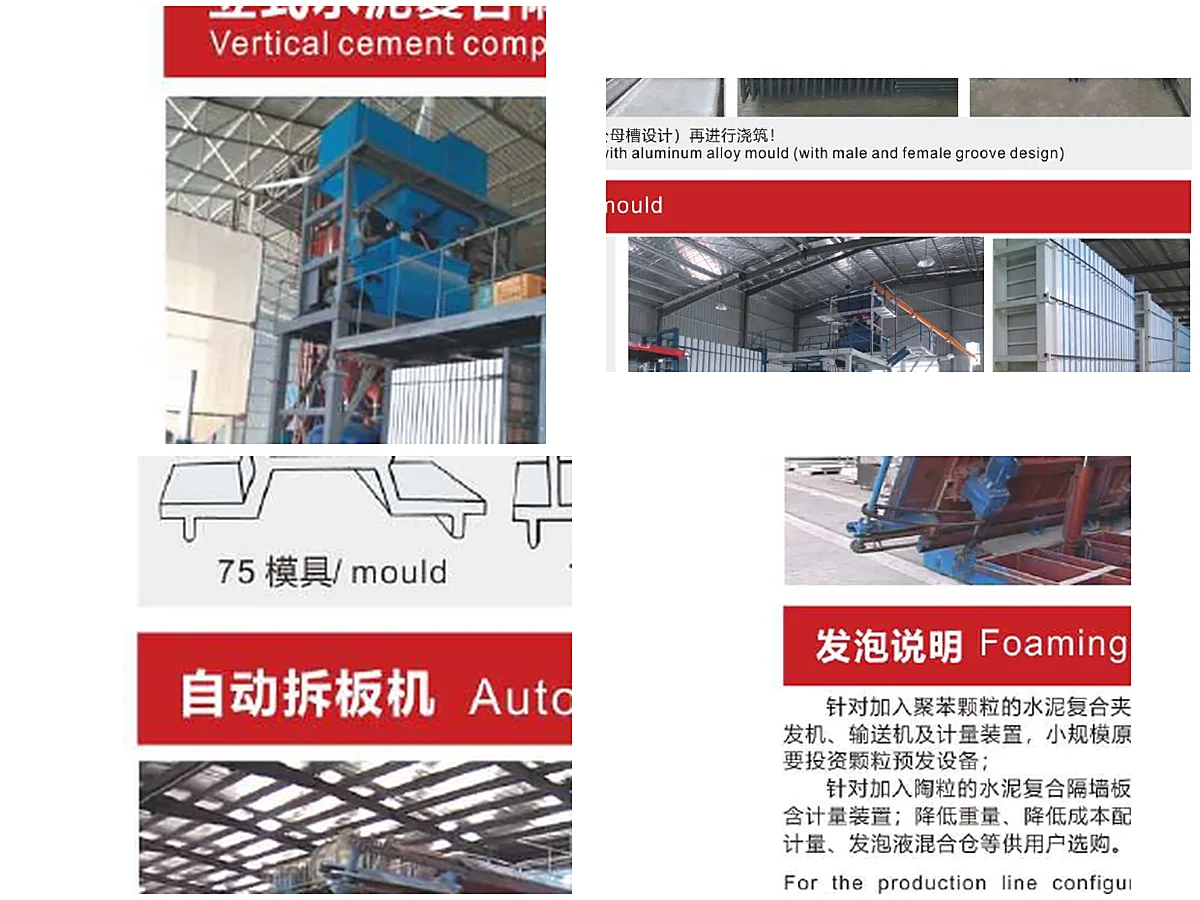
The QST1800 wallboard line produces lightweight foamed cement panels through an automated mould circulation, from raw material preparation to packed finished board. Aluminium alloy moulds are assembled to the panel specification and locked with male and female groove fixings, so panel edges come out straight and ready to join on site. Reinforcement bar or wire mesh is placed in the mould before pouring for impact and crack resistance. Cement, fly ash and EPS beads are proportioned by a metering system, then mixed and foamed in a twin-shaft mixer into a uniform lightweight slurry. A mobile mould cart carries the mould to the pouring station, the slurry is injected to fill the cavity completely, and the cart then moves it to the curing area. After setting, an automatic plate removal machine strips the panels from the moulds, the panels go to curing, and the empty moulds return to assembly through a circulation system. Finished boards are inspected, packed and dispatched, so the line runs as a closed loop with little manual handling between stages. Mould count and curing area, not pouring speed, set the daily output ceiling, so both are fixed when the line is sized.

Category
Gypsum / AAC / Lightweight Panel Lines
Customization
Designed to your site and target output
Warranty
12 months on main components

Or call us: +86 158 8041 2886

Product Description

<h2>Mould Assembly and Reinforcement Placement</h2><p>The cycle starts with the mould. Aluminium alloy side forms are assembled to the wall panel specification and locked with male and female groove fixings around the perimeter. Those fixings shape the panel edge as it cures, so the board arrives on site with a straight profile that can be joined without extra dressing.</p><p>Before pouring, a reinforcement bar or a wire mesh is placed inside the mould. Its job is structural rather than cosmetic: the mesh takes the tensile load in a foamed panel, which improves impact resistance and limits cracking during handling and installation.</p><h2>Metering, Foaming and Pouring</h2><p>Cement, fly ash and EPS beads are proportioned by a metering system and fed to a twin-shaft mixer, where high speed mixing and foaming produce a uniform lightweight slurry. Metering accuracy decides whether the panel hits its target density, and density in turn decides strength, weight and thermal performance.</p><p>The mixed slurry is injected into the mould through the pouring system, filling the cavity completely and leaving no voids or trapped bubbles, since a hole in the panel is a weak point that inspection cannot repair. The mobile mould cart then moves the filled mould to the curing area, where the slurry sets and solidifies in shape.</p><h2>Demoulding and Mould Circulation</h2><p>Once the board has set, an automatic plate removal machine lifts the finished panel out of the mould. Panels continue to the curing zone for their remaining curing period, while the empty moulds travel back to the assembly station on a circulation system and are refilled.</p><p>That return loop is what sets the production rate of the line. The number of moulds in circulation, not the nominal pouring cycle, decides daily output, which is why mould count is the first figure to agree on when a plant is sized.</p><h2>Inspection, Packing and Dispatch</h2><p>After curing, each wallboard is inspected for dimensions, edge quality and surface defects. Boards that pass are packed and prepared for dispatch, with rejected units pulled before they reach transport.</p><p>Because the line works as a closed loop, the crew is mainly monitoring stations rather than handling panels, which keeps product quality consistent across shifts and reduces the physical load on the operators. Mould cleaning and release agent application remain the two housekeeping tasks worth scheduling daily.</p><p>Mould cleaning and release agent application are the two routines worth scheduling daily, since slurry bonds to an unclean mould face and reappears as chipped edges at final inspection.</p>

Key Features

  • Aluminium alloy moulds with male and female groove fixings produce straight, joinable panel edges.
  • Wire mesh or reinforcement bar placed before pouring raises impact and crack resistance of panels.
  • Cement, fly ash and EPS beads are proportioned by a metering system before twin-shaft mixing.
  • Automatic plate removal machine strips cured panels while moulds return through a circulation system.
  • Closed-loop flow from mould assembly to packed dispatch keeps manual panel handling low.
  • Inspection of dimensions, edges and surface before packing holds panel quality across shifts.

Send us your requirements

Tell us your target output and the raw materials you have, and we will send a detailed quotation.

Technical Parameters

Parameter QST1800
Model QST1800
Product Lightweight foamed cement wallboards
Mould material Aluminium alloy with male and female groove fixings
Reinforcement Steel reinforcement bar or wire mesh placed in the mould
Raw materials Cement, fly ash, EPS beads
Mixer Twin-shaft mixer with foaming and high speed mixing
Mould transport Mobile mould cart to pouring and curing stations
Demoulding Automatic plate removal machine with mould circulation
Flow Closed loop from mould assembly to packed dispatch

The pictures and parameters above are for reference only, and the final interpretation right belongs to our company. Final specifications are confirmed in the contract.

Inquire about this machine

Send us your requirements for the QST1800 and we will come back with the machine list, a layout drawing and a price.

  • The products you want to make and their sizes
  • The output you need per shift
  • The raw materials available to you
  • Site area and available power supply

Enquiry about: QST1800, QST1800 Foamed Cement Wallboard Production Line

We reply within 12 hours. Your information is never shared.

Frequently Asked Questions

What makes the panel edge ready for installation?
The aluminium alloy side forms are locked with male and female groove fixings around the mould perimeter. Those fixings shape the edge while the slurry sets, so the finished board comes out with a straight, matched profile. On site the panels join without extra dressing, which shortens dry wall installation and gives a tidier joint line than cut edges.
Why is reinforcement placed inside the mould?
A steel bar or wire mesh is positioned before pouring to carry tensile load in a panel that is otherwise low in density. It raises impact resistance and limits cracking during demoulding, transport and installation. Insulation and light weight come from the foamed structure, while the mesh supplies the mechanical behaviour that lets the board survive handling on a real site.
What determines the daily output of the line?
The number of moulds in circulation decides it, not the pouring cycle alone. Each mould runs through fill, set, demoulding and return before it can be used again, so adding moulds and matching curing area is usually the cheapest way to raise output. Agree on mould count before ordering, because it drives both the line layout and the curing space.
Which raw materials does the line consume?
Cement, fly ash and EPS beads, proportioned by a metering system before they enter the twin-shaft mixer. Foaming and high speed mixing then produce a uniform lightweight slurry. Metering accuracy sets the achieved density, so a plant that checks bead dosing and slurry density per batch will get more consistent panel weight than one that only checks the finished board.

Related Products

Semi-dry Gypsum Line, Semi-Dry Fully Automatic Gypsum Block Production Line
Semi-dry Gypsum Line

Semi-Dry Fully Automatic Gypsum Block Production Line

Water-to-gypsum ratio cut to about 30%, blocks go to the warehouse without drying or airing, and comfortably exceed JC/T 698-2010.

  • Configured to your target output; block strength well above JC/T 698-2010
View details
WhatsApp Us