QST1200 / QST1800
Hard Rock Cone Crusher Production Line QST1200 QST1800
Closed-loop two-stage crushing and screening for granite, basalt and iron ore.
View details
Turn demolition concrete, brick and stone into graded recycled aggregate and sand.
This line converts demolition and construction debris into usable raw material. Discarded concrete, brick, stone and mixed rubble are loaded through a grate feeder that evens the flow and pre-screens fine soil before anything reaches the crusher. After coarse crushing, a high-frequency vibrating screen takes off material finer than ten millimetres as waste soil while the coarser aggregate carries on. Two impurity removal steps, air separation plus manual sorting, strip out fabric, plastic and foam along with scrap iron and rebar, so crusher hammers and liners are protected. The cleaned aggregate then enters a secondary crusher and a second screening pass, which yields several grades of recycled aggregate and recycled sand. Those grades are used for brick making, road base backfilling and ready-mixed mortar, so material taken off a demolition site goes back into new construction instead of a landfill. Crushing, screening and cleaning follow one another in a compact flow, which suits sites where space is limited.
<h2>What the Line Processes</h2><p>Urban demolition, road reconstruction and building work all produce a mixed waste stream: broken concrete, waste brick, stone fragments and general rubble. This line treats that stream as a raw material rather than a disposal problem. Crushing, screening, impurity removal and air separation are combined in one flow, so the output is recycled aggregate and recycled sand that can be sold or reused on site.</p><h2>Step by Step Process</h2><p>A grate feeder starts the flow. Its grate structure pre-screens fine soil and light debris before the material reaches the primary crusher, which cuts the crushing load and extends equipment life. Coarse crushed material then travels on a sealed conveyor to a high-frequency vibrating screen. Everything finer than ten millimetres is collected as waste soil, while the coarse aggregate left on the screen moves forward to cleaning and secondary reduction.</p><h2>Removing Impurities Before They Cause Damage</h2><p>Two stages handle contamination. Air separation uses directional airflow to lift out light material such as fabric, plastic and foam, while manual sorting removes large pieces of scrap iron, rebar and other metal. Cleaning the feed at this point keeps foreign objects away from the hammers and liners in the secondary crusher, which is what allows the plant to run long shifts without unexpected repairs.</p><h2>Grading the Recycled Output</h2><p>After secondary crushing the material is screened again. Because the second screen is set for the intended end use, the plant can produce different grades of recycled aggregate from one feed, including graded material for brick making, road base backfilling and ready-mixed mortar. Iron removal steps run through the circuit as well, lowering the metal content of the finished product. This is what makes recycled material acceptable to buyers who would otherwise insist on quarried stone.</p><h2>Layout and Siting</h2><p>The line is arranged as a compact flow rather than a scattered set of machines, so it fits sites where space is limited. Sealed conveyors between stages keep dust inside the process, and the crushing and screening points can each be fitted with dust collection. Once the plant is set up, operation is continuous, with only the manual sorting station needing attention from staff.</p><h2>Why Producers Choose Recycling</h2><p>For demolition contractors and building material producers the value is straightforward: tipping fees fall, raw material costs fall, and the plant turns a waste stream into a product with a sale price. Project owners also meet waste reduction, harmlessness and resource recovery targets without changing their normal site workflow. In cities where demolition volumes keep rising and natural aggregate supply keeps tightening, that combination is usually decisive.</p>
Tell us your target output and the raw materials you have, and we will send a detailed quotation.
| Parameter | QST1200 / QST1800 |
|---|---|
| Model | QST1200 / QST1800 |
| Input Materials | Discarded concrete, brick, stone and mixed construction debris |
| Feeder | Grate feeder with pre-screening of fine soil |
| Primary Screen | High-frequency vibrating screen |
| Waste Soil Cut-off | Material finer than 10 mm |
| Impurity Removal | Air separation plus manual sorting |
| Iron Removal | Multiple iron-removal steps through the circuit |
| Output | Recycled aggregate and recycled sand in several grades |
The pictures and parameters above are for reference only, and the final interpretation right belongs to our company. Final specifications are confirmed in the contract.
Send us your requirements for the QST1200 / QST1800 and we will come back with the machine list, a layout drawing and a price.
Enquiry about: QST1200 / QST1800, Construction Waste Recycling Production Line QST1200 QST1800
Closed-loop two-stage crushing and screening for granite, basalt and iron ore.
Manufactured sand from 50 to 500 t/h with MR and DM sand makers, screening and washing.
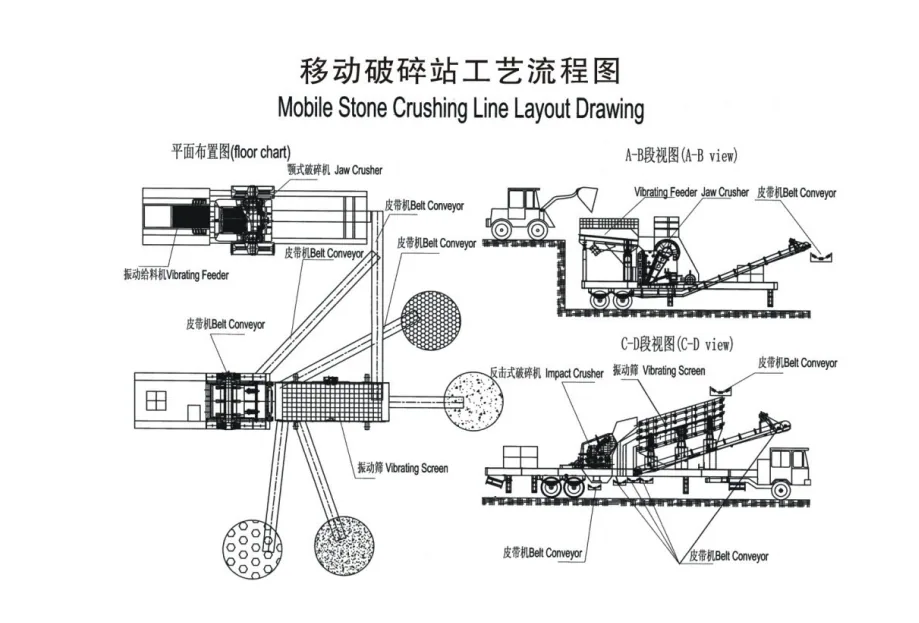
Jaw and impact mobile crushers in a two-stage closed loop that moves with the job.