QST1200 / QST1800
Hard Rock Cone Crusher Production Line QST1200 QST1800
Closed-loop two-stage crushing and screening for granite, basalt and iron ore.
View details
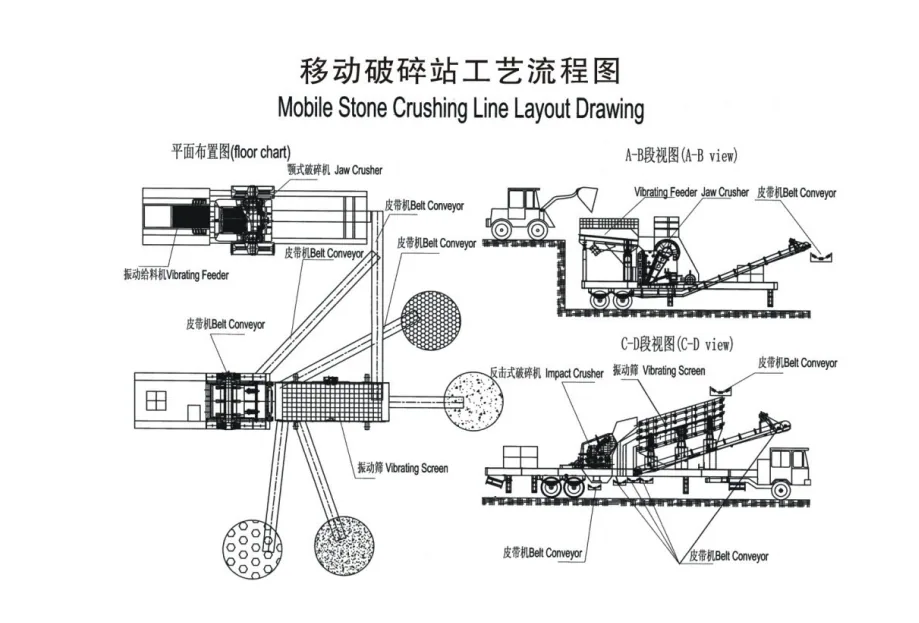
Jaw and impact mobile crushers in a two-stage closed loop that moves with the job.
A single crusher rarely covers every stage of a crushing job, from coarse reduction through medium and fine crushing to screening. This mobile line solves that by pairing a jaw-type mobile crusher for the coarse stage with an impact-type mobile crusher for medium and fine crushing and screening, and by adding conveyors and an iron remover. Feed goes into the hopper by loader, then a vibrating feeder spreads it evenly into the jaw crusher. Crushed material leaves on the built-in belt, passes an iron remover that pulls out ferrous scrap, and enters the impact crusher for further reduction. A vibrating screen grades the result; qualified sizes are stockpiled by belts of different specifications while oversize material returns to the impact crusher for re-crushing. The whole flow runs without manual intervention, which keeps labour costs down and product grading consistent. Three standardised configurations let operators match the plant to small, medium or larger production targets.
<h2>Why a Mobile Crushing Line</h2><p>Crushing projects rarely stay in one place. Aggregate production, construction waste recycling and mining work all involve pits, demolition sites and stockyards that shift over time. Moving a fixed plant between them is expensive, and a single crusher cannot cover the whole process from coarse reduction to medium and fine crushing and screening. A mobile line keeps the equipment on wheels or tracks and brings the crushing capacity to the material instead.</p><h2>The Two-Stage Configuration</h2><p>The line is arranged as coarse crushing plus medium and fine crushing and screening. A jaw-type mobile crusher takes the coarse stage, and an impact-type mobile crusher handles the second stage and the screening duty. Conveyors and an iron remover complete the set. This two-stage arrangement is what makes a closed loop possible on mobile equipment.</p><h2>Step by Step Operation</h2><p>Material is loaded into the hopper by loader, and a vibrating feeder spreads it evenly into the jaw crusher so the unit is never choked. Coarse crushed material leaves on the built-in belt conveyor and travels either to an intermediate stockpile or straight to the impact crusher. On the way it passes an iron remover that pulls out ferrous impurities, which prevents damage to downstream equipment and keeps the line running steadily. The impact crusher carries out medium and fine crushing, and a vibrating screen grades the product. Qualified sizes are taken away by belts of different specifications to designated storage areas, while oversize material returns to the impact crusher and is reduced again.</p><h2>Automatic, Continuous Flow</h2><p>The entire process needs no manual intervention once running. Material moves in a continuous flow from hopper to stockpile, which raises production efficiency and holds product quality constant through the shift while keeping labour costs low. Because the screen and return loop close the circuit, the finished aggregate has a uniform particle size and a reasonable gradation rather than the mixed curve typical of a single-pass unit.</p><h2>Matching the Plant to the Job</h2><p>To serve different production scales, the line is offered in three standardised configurations covering small, medium and larger output targets. Each one uses the same jaw and impact pairing, so a contractor can move up in capacity without relearning the process. The modular build also means units can be added or rearranged as a project changes, and the plant can be relocated when the pit is worked out. Because relocation is part of normal use, belt sections and the control panel are arranged for quick removal and reassembly at the next site.</p>
Tell us your target output and the raw materials you have, and we will send a detailed quotation.
| Parameter | QST1200 / QST1800 |
|---|---|
| Model | QST1200 / QST1800 |
| Coarse Crushing Unit | Jaw-type mobile crusher |
| Medium and Fine Unit | Impact-type mobile crusher with screening |
| Feed System | Hopper with vibrating feeder and built-in belt conveyor |
| Iron Removal | Iron remover installed on the conveying line |
| Configurations | Three standardised configurations |
| Operation | Automatic continuous closed-loop flow |
The pictures and parameters above are for reference only, and the final interpretation right belongs to our company. Final specifications are confirmed in the contract.
Send us your requirements for the QST1200 / QST1800 and we will come back with the machine list, a layout drawing and a price.
Enquiry about: QST1200 / QST1800, Mobile Crushing Station Production Line QST1200 QST1800
Closed-loop two-stage crushing and screening for granite, basalt and iron ore.
Turn demolition concrete, brick and stone into graded recycled aggregate and sand.
Manufactured sand from 50 to 500 t/h with MR and DM sand makers, screening and washing.