QST1200 / QST1800
Construction Waste Recycling Production Line QST1200 QST1800
Turn demolition concrete, brick and stone into graded recycled aggregate and sand.
View details
Closed-loop two-stage crushing and screening for granite, basalt and iron ore.
This hard rock crushing line is built around a two-stage closed loop: a coarse crusher prepares the stone, and a cone crusher performs secondary fine crushing and shaping by laminated compression. Automated feeding delivers large raw stones at a constant rate so downstream units never run blocked or overloaded. Crushed material travels by belt conveyor to a vibrating screen, where it is split into graded aggregates, and oversize stone returns automatically to the cone crusher for re-crushing. The result is high raw material utilisation and a finished product with a controlled particle shape and low flakiness content. Discharge size can be adjusted manually, so a single line can serve several aggregate specifications. The equipment handles hard and abrasive rock such as granite, river pebbles, basalt and iron ore, and it is aimed at medium and large sand and gravel plants that need steady daily output. Typical duties include aggregate processing, road construction, building material production and concrete product manufacturing.
<h2>What This Production Line Does</h2><p>The line is a complete crushing and screening system for high-hardness stone. It takes run-of-quarry rock such as granite, river pebbles, basalt or iron ore and turns it into graded aggregate in a closed loop. Because the flow is two-stage, coarse followed by cone fine crushing, hard and abrasive material can be reduced in fewer passes and with less wear on any single unit.</p><h2>Working Principle</h2><p>An automated feeder releases large raw stones at a constant rate and in measured quantities into the coarse crusher, which protects everything downstream from sudden overloads and blockages. The partly crushed stone then moves by belt conveyor to the cone crusher, where it is shaped and reduced again under laminated compression. From there the material enters a vibrating screen for multi-layer classification. Stone that meets the required size leaves as finished aggregate, while oversize material is carried back by a return conveyor and re-crushed, so almost nothing is discarded.</p><h2>Adjustable Output and Closed-Loop Recovery</h2><p>Discharge particle size is set manually on site, which lets one installation produce several aggregate grades without adding equipment. The return loop keeps quality consistent from shift to shift, because any off-spec stone is simply cycled again instead of being sold as waste. Operators see a streamlined workflow with few transfer points, which keeps running costs and downtime low compared with conventional multi-unit crushing setups.</p><h2>Why Two Crushing Stages</h2><p>Hard rock breaks predictably under compression, which is why the line uses a cone crusher for the fine stage rather than relying on a single unit. A single pass over granite or basalt tends to leave a flaky product with a poor grading curve and puts heavy wear on hammers and liners. Working on the laminated compression principle, the cone squeezes stone grain against grain between a moving mantle and a fixed bowl, so the finished material is cubical and evenly graded. Combining that with a coarse stage upstream and a screen with a return loop downstream gives the circuit a stable product curve that is easy to control.</p><h2>Where It Fits</h2><p>Medium and large sand and gravel enterprises use this configuration as their main crushing circuit. It also suits road construction projects that need engineered aggregate, building material plants, and concrete product manufacturers who want a dependable, self-contained supply of graded stone. For quarry operators working hard rock, the combination of a cone crusher and an automatic return loop is usually the most economical route to a uniform finished product.</p>
Tell us your target output and the raw materials you have, and we will send a detailed quotation.
| Parameter | QST1200 / QST1800 |
|---|---|
| Model | QST1200 / QST1800 |
| Crushing Stages | Two-stage: coarse crushing plus cone fine crushing |
| Feed Method | Automated feeder with constant-rate delivery |
| Screening | Vibrating screen with multi-layer classification |
| Discharge Size | Manually adjustable |
| Suitable Materials | Granite, river pebbles, basalt, iron ore |
| Circuit Type | Closed loop with automatic return of oversize material |
The pictures and parameters above are for reference only, and the final interpretation right belongs to our company. Final specifications are confirmed in the contract.
Send us your requirements for the QST1200 / QST1800 and we will come back with the machine list, a layout drawing and a price.
Enquiry about: QST1200 / QST1800, Hard Rock Cone Crusher Production Line QST1200 QST1800
Turn demolition concrete, brick and stone into graded recycled aggregate and sand.
Manufactured sand from 50 to 500 t/h with MR and DM sand makers, screening and washing.
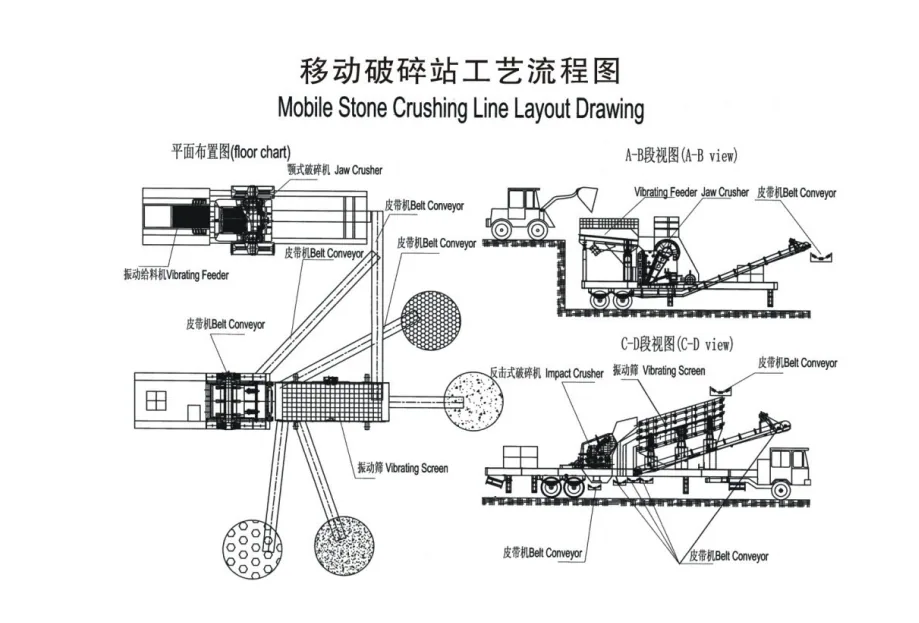
Jaw and impact mobile crushers in a two-stage closed loop that moves with the job.